Compeyson
Great ExpectationsCompeyson is a well-presented criminal whose education and command of genteel manners repeatedly shield him while his partner, Abel Magwitch, bears the greater burden of their crimes. His history connects the fraud that first entangled Magwitch with the deception surrounding Miss Havisham, and his later pursuit of Pip’s group turns that history into an immediate threat. In the account of his life and capture, polished appearance is not a sign of moral worth: it is an advantage Compeyson knows how to use.
Identity and Criminal Partnership
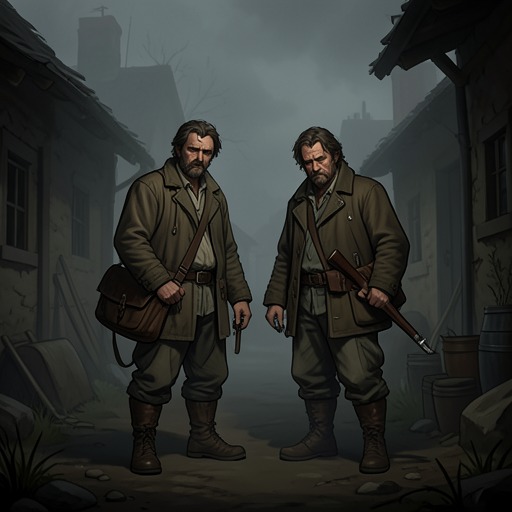
Magwitch recalls meeting Compeyson at Epsom races more than twenty years earlier. The contrast was visible at their first encounter: Compeyson wore a handsome suit and displayed a watch, chain, ring, and breast-pin. He presented himself as a gentleman, had attended a public boarding school, and was skilled in the manners of genteel society. Magwitch, by contrast, was a poor, rough-edged man with little education and a record of imprisonment.
Compeyson recruited Magwitch as a partner, but the partnership was unequal from the outset. Their business included swindling, forged handwriting, and passing stolen banknotes. Compeyson planned the schemes, kept himself out of direct danger, and arranged matters so another person took the risks and received the blame. Magwitch describes him as cold and calculating; the account of their crimes bears out the practical force of that judgment.
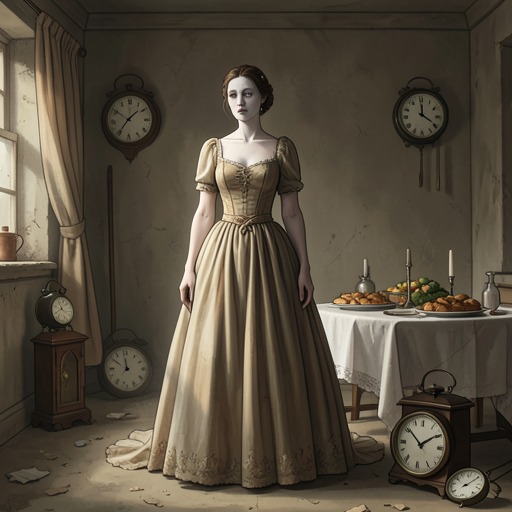
Their criminal circle also included Arthur, the sickly son of Miss Havisham. Arthur and Compeyson had previously made money through a scheme against a wealthy woman, but Compeyson’s gambling dissipated the profits. The revelation that Arthur was Miss Havisham’s brother, and that Compeyson had professed to be her lover, ties the fraudster to the emotional history of Satis House. His apparent gentility therefore belongs not only to the criminal partnership with Magwitch but also to the deception that helped shape Miss Havisham’s life.
Trial and Unequal Punishment
When Magwitch and Compeyson were committed for felony over the circulation of stolen notes, Compeyson demanded separate defences and no communication between them. Magwitch was so poor that he sold nearly all his clothes to obtain legal representation. At trial, the difference between the defendants’ social presentation became part of the case against them: Compeyson appeared as a well-brought-up younger man, while Magwitch was presented as an older, previously convicted offender.
The prosecution evidence, as Magwitch remembers it, seemed to place him at the center of the transactions. Witnesses identified him, the money had been paid to him, and he appeared to have carried out the work and received the proceeds. Compeyson’s defence then emphasized their visible difference in education and respectability. His counsel depicted Compeyson as seldom seen in the schemes and only suspected, while Magwitch was repeatedly identified and already known to the courts.
The court’s treatment of character deepened the imbalance. Compeyson’s schooling, acquaintances, and social associations were presented as evidence in his favor; Magwitch’s previous convictions counted against him. Compeyson could make a polished speech and invoke his good character, whereas Magwitch could offer only a blunt denunciation of his partner. The jury recommended Compeyson to mercy for his character and cooperation, while finding Magwitch guilty without a similar recommendation. Compeyson received seven years; Magwitch received fourteen. The disparity shows how Compeyson’s education and manner could be converted into credibility, while Magwitch’s poverty and record made him appear the more culpable man.
Connections to Miss Havisham and Molly
Compeyson’s past with Miss Havisham is disclosed indirectly during Magwitch’s account. Herbert writes a note identifying Arthur as Miss Havisham’s brother and Compeyson as the man who had professed to be her lover. The brief revelation changes the meaning of Compeyson’s history: his schemes were not confined to Magwitch’s criminal world but reached into the events behind Miss Havisham’s abandoned wedding and lasting grief.
Compeyson is also connected to Molly through the account of her murder trial. Wemmick explains that Jaggers defended her against a charge based on circumstantial evidence, including signs that prosecutors interpreted as proof of violence. Jaggers challenged the prosecution’s reading of the scratches on her hands, pointing to brambles and traces of her clothing as an alternative explanation, and the jury acquitted her. Molly entered Jaggers’s service immediately after her acquittal. The later explanation of Magwitch’s history clarifies that Molly had shared years of hardship with him, had borne his child, and disappeared after the trial; Compeyson knew why Magwitch had stayed away and used that knowledge to keep him poorer and harder at work. The connection makes Compeyson’s influence extend beyond the courtroom: he exploited Magwitch’s effort to avoid becoming a cause of Molly’s death.
Pursuit and Final Confrontation
Years after the trial, Compeyson is recognized by Mr. Wopsle at the theatre, behind Pip. The sight unsettles Pip because the man seems to have followed him during the period when Magwitch is being hidden. Wopsle cannot explain when Compeyson arrived, but remembers him as dressed respectably, apparently in black, and associated with Pip from the old village. The encounter confirms that Compeyson has returned from the background of Magwitch’s story to threaten the present plan.
Orlick later taunts Pip with the warning that Compeyson and others know about Magwitch and may be a match for him. He says that Compeyson has had reliable information about Magwitch abroad and that Pip’s attempt to hide his uncle has not escaped notice. The warning anticipates the interception on the river, where a galley identifies Magwitch as a returned transport and calls for his arrest. As the boats collide, Magwitch recognizes the cloaked prisoner in the galley as the other convict from long ago: Compeyson.
The two men go overboard together during the confusion. Magwitch later tells Pip that, when he reached for Compeyson’s cloak to identify him, Compeyson staggered up and back, and both fell into the water. He says they struggled below the surface before he freed himself and swam away. The officer steering the galley gives the same account. Magwitch is recovered, injured and shackled; Compeyson is not found. The confrontation ends their long criminal partnership, but Compeyson’s death is reported through Magwitch’s account rather than shown directly.
Narrative Role and Significance
Compeyson’s defining advantage is the gap between appearance and conduct. He uses the signs of respectability—education, clothes, speech, and social connections—not merely to conceal criminal activity, but to make the law read him differently from Magwitch. The trial turns those signs into character evidence, granting Compeyson leniency while treating Magwitch’s poverty and prior convictions as proof of deeper guilt.
His story also binds several otherwise separate strands of the novel. He was Magwitch’s criminal partner, the professed lover linked to Miss Havisham’s past, the source of information used to exploit Magwitch, and the pursuer whose recognition precipitates the failed escape. His final appearance makes the past physically present on the river, where the partnership’s history ends in a struggle and Magwitch’s arrest. Through Compeyson, the novel shows how a cultivated public identity can function as a practical instrument of evasion, while the consequences of crime fall most heavily on the person least able to command the language and institutions of respectability.